Our Faith
Modesty, dress, and hair.
Why we believe the way we dress and carry our bodies is part of a life set apart for God.
We believe holiness is not only a matter of the heart. It shows itself in how we live, and that includes the way we dress and carry ourselves. A Christian's outward appearance is meant to reflect an inward consecration to God. This is not about earning His favor, and it is not about judging the stranger who walks through our doors. It is about love, reverence, and a desire to look like what we say we are.
If you are visiting, you do not need to already share all of these convictions to worship with us, and no one will single you out for not yet measuring up to them. We do ask one thing of everyone, though: come dressed decently and modestly. This is the Lord's house, and it is no place for miniskirts, shorts, or beachwear. Simply dress the way you would to honor Him. What follows is what we believe and practice as a people, laid out plainly so you know where we stand.
The heart behind it
We do not believe a person is saved by the length of their hair or the cut of their clothes. Modesty is the fruit of a changed life, not the way to earn one. When the Lord comes into a heart, that new life begins to show on the outside, the way the wave sheaf showed the harvest had begun.
That's the way the true believer in Christ is this morning; on the outside is the display of the Blood of the Lord Jesus, that shows something took place on the inside.
Bro. William Branham — Why Little Bethlehem? (1958)
A believer becomes, as Paul said, a living letter that everyone around them reads. How we present ourselves preaches a sermon before we ever open our mouths.
Life is what makes you what you are. And the life that is within you, makes you the written epistle, read of all men.
Bro. William Branham — Thirsting For Life (1958)
So we do not dress the way we do to be seen of men, but because we belong to God and want to honor Him. A separated people will look separated.
What the Scriptures say
Our convictions on this are not new rules of our own making. They rest on the plain words of Scripture. The apostle Paul instructed the women of the church directly:
That women adorn themselves in modest apparel, with shamefacedness and sobriety; not with broided hair, or gold, or pearls, or costly array; but (which becometh women professing godliness) with good works.
1 Timothy 2:9-10
Peter taught the same, drawing the eye from the outward to the inward:
Whose adorning let it not be that outward adorning of plaiting the hair, and of wearing of gold, or of putting on of apparel; but let it be the hidden man of the heart, in that which is not corruptible, even the ornament of a meek and quiet spirit, which is in the sight of God of great price.
1 Peter 3:3-4
On hair, Paul appealed not only to revelation but to nature itself:
Doth not even nature itself teach you, that, if a man have long hair, it is a shame unto him? But if a woman have long hair, it is a glory to her: for her hair is given her for a covering.
1 Corinthians 11:14-15
And the distinction between man and woman, in dress as in all else, goes back to the Law:
The woman shall not wear that which pertaineth unto a man, neither shall a man put on a woman's garment: for all that do so are abomination unto the LORD thy God.
Deuteronomy 22:5
For the women
We believe the Scriptures above were given to be kept, not explained away. Through the ministry of Brother William Branham, they were preached plainly to this generation.
Her hair
We believe a woman's long, uncut hair is her glory and her God-given covering, and we encourage our sisters to let it grow.
Hair is given to her for a covering. Did it say she'd be given a hat? No, you ought to let your hair grow. That's the difference.
Bro. William Branham — Questions And Answers On Hebrews #3 (1957)
The Bible said that a woman that'll bob her hair dishonors her head. And you women that hasn't the common decency to let your hair grow out, like God told you to.
Bro. William Branham — Presuming (1962)
Her dress
We believe a woman should dress modestly and in feminine apparel, wearing dresses or skirts rather than garments that belong to a man, keeping the distinction God set between the sexes.
It's an abomination in the sight of God for a woman to put on a garment that pertains to a man. And God is God and never changes; He's the infinite God.
Bro. William Branham — The Rejected King (1960)
He also warned, soberly, that immodest dress is no small thing, and that a woman who dresses to be looked upon bears responsibility for the sin it stirs:
But if that sinner looks upon you to lust after you, when he answers for adultery, you are the guilty one who made him do it.
Bro. William Branham — As The Eagle Stirs Her Nest (1958)
Her adorning
We believe in the adorning Peter described, a meek and quiet spirit, rather than painted features and outward ornament.
There was only one woman in the Bible that ever painted her face, and that was Jezebel.
Bro. William Branham — A Testimony On The Sea (1962)
The head covering
Some churches teach that a woman should wear a veil or a hat to church as the covering Paul speaks of in 1 Corinthians 11. We believe the chapter answers that question for itself. Paul says a woman who prays uncovered dishonors her head 1 Corinthians 11:5-6, and then he tells us plainly what the covering is:
But if a woman have long hair, it is a glory to her: for her hair is given her for a covering.
1 Corinthians 11:15
So we believe a woman's own long, uncut hair is the covering God gave her. It is not a cloth veil or a hat, but the hair itself.
The 15th verse said her long hair is given to her for a covering, not a hat. Her long hair is her covering.
Bro. William Branham — Oneness (1962)
And her hair is her covering; not a hat, lady. Her hair is her covering, the Bible said.
Bro. William Branham — A Thinking Man's Filter (1965)
This is why a woman's hair is more than a preference to us. Her uncut hair is the very covering the Scripture appoints, a token of God's order of headship. 1 Corinthians 11:10
Jewelry and the wedding ring
The same Scriptures that call for modest apparel also speak to ornament. Paul wrote that women should adorn themselves "not with broided hair, or gold, or pearls, or costly array" 1 Timothy 2:9, and Peter set "the wearing of gold" over against "the hidden man of the heart." 1 Peter 3:3 So we believe a Christian woman's beauty is meant to be inward, and we discourage wearing ornamental gold and jewelry for show.
The wedding ring is the one exception, and an important one. It is not ornamental jewelry but a necessary token of the marriage covenant. We believe a married woman should wear her wedding band, for it tells everyone she meets that she is married and belongs to her husband. Brother Branham did not condemn the wedding ring; he treated it as a marriage token, and noted that even in Bible times a married woman wore such a token to show she was married.
In the Bible they wore wedding rings, only it was a tablet they called it, around their head, nine pieces of coin in it, to show they were married.
Bro. William Branham — Questions And Answers #2 (1964)
So while gold worn for show has no place, the plain wedding band has every place. It honors the covenant of marriage and bears witness, quietly and constantly, that a husband and wife belong to one another.
For the men
The call to holiness rests just as fully on the men. We believe a man should keep the appearance God gave a man, including short hair, and carry himself soberly, leading his home in reverence and the fear of the Lord.
It's a shame for a man to have long hair. That's a woman's place. God made a man different from a woman: in looks, and in everything else.
Bro. William Branham — Questions And Answers On Hebrews #3 (1957)
Then a husband ought to live such a life before his wife that his wife could reverence him as a son of God.
Bro. William Branham — A Thinking Man's Filter (1965)
Our children
Holiness is meant to be handed down. We believe God places on parents, fathers and mothers alike, the responsibility to raise their children for His Kingdom, bringing them up in the nurture and admonition of the Lord. Ephesians 6:4
So the responsibilities is placed upon you mothers and you fathers to raise these children for the Kingdom of God. And I'm sure that's your heart's desire.
Bro. William Branham — The True Easter Seal (1961)
That work is done less by lecture than by example. Children watch the life lived in front of them, and a home given to prayer shapes them more than anything the world can offer. Proverbs 22:6
I think that's a very fine example for we parents today, to set an example before our children. You'll live your best and your worst at home.
Bro. William Branham — Influence (1963)
The little children will pray, around the table. They'll pray before they go to bed. Mother and father will join hands and pray. And as long as they continue like that, they'll stay a family.
Bro. William Branham — The Influence Of Another (1962)
We also believe in loving correction. The Scripture is plain that discipline is part of raising a child who will not depart from the way. Proverbs 22:15
As a father or a mother, you've got to face the responsibility of raising that child, because the Bible said, "Spare the rod and you'll spoil your son."
Bro. William Branham — A Man Running From The Presence Of The Lord (1965)
Our aim is not merely well-behaved children, but children who come to know the Lord for themselves and carry the faith into their own homes.
A look back
What the world now calls old-fashioned was, until quite recently, simply the way things were. The standards we hold were the ordinary standards of Western Christian society for generations. Nearly all of the changes came in a single century.
Long hair
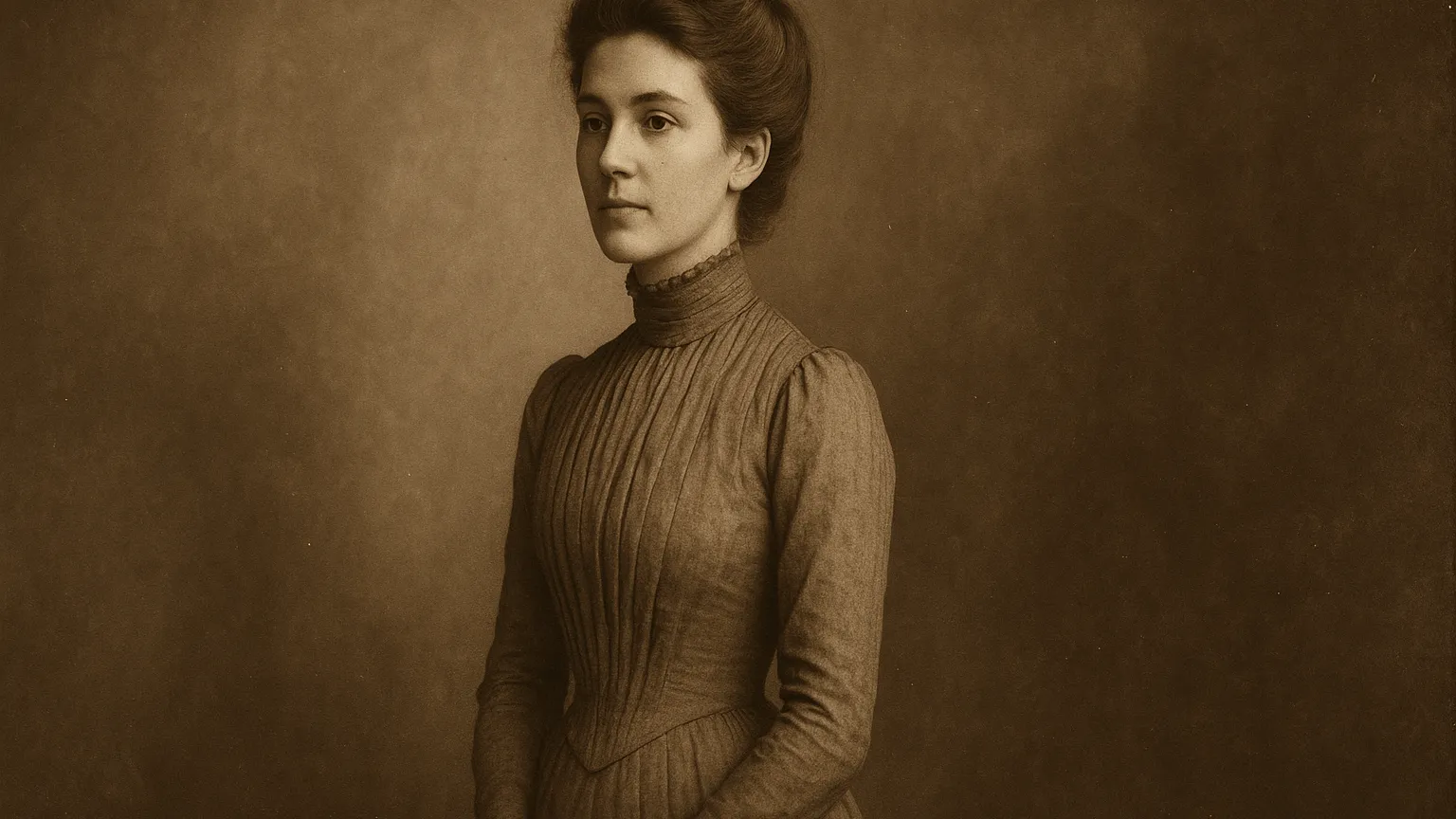
For centuries, long hair was a woman's "crowning glory." Through the Victorian era it marked her femininity, and short hair on a woman was associated only with illness or disgrace. The "bob" first drew notice around 1915, then swept in with the flappers of the 1920s. It was considered shocking, a deliberate break with everything that had come before. (Smithsonian)
Women in trousers
Trousers on a woman were long considered improper, and in some places were even restricted by law. The shift came only through the 20th century: Chanel's sportswear, Marlene Dietrich's tuxedo on screen in 1930, the factory workwear of the World Wars, and Yves Saint Laurent's "Le Smoking" in 1966. Broad acceptance did not arrive until the 1960s and 70s. (CNBC)
Makeup
Visible cosmetics were widely thought disreputable, associated with actresses and prostitutes, all through the 1800s. The very word "make-up" belonged to the theater until Max Factor began using it for the public around 1920. Only then, carried by Hollywood, did painted features move from scandalous to expected, almost overnight. (Victorian-era cosmetics)
Hemlines
For centuries skirts reached the floor or the ankle. Hemlines rose sharply for the first time in the 1920s, then again with the miniskirt of the mid-1960s. Each leap was a new departure, not a return to anything older. (V&A)
We are not trying to live in another century, and we are not measuring anyone's heart by a hemline. But these were real departures from a long and settled Christian standard, and we have simply chosen to keep to the older, scriptural pattern.
A word of grace
These are convictions we grow into as the Lord works in us.
We hold these things dearly, but we hold them in love. We do not stand at the door with a measuring tape. Come and worship with us as you are, and let the Lord do His work in His time. If you have questions, we would be glad to talk.